Showing posts with label Stories By Alice. Show all posts

Friday, July 12, 2013

The Assassination of Julius Caesar, by Alice

The assassination of Julius Caesar, an event that would change the face of the Roman Empire forever.  Conspirators claimed that this action was taken for the good of Rome, while historians are left to argue whether this was the case or not. 
Some believe that these ‘patriotic’ Romans were in fact rich nobility afraid of what the future, if in Caesar’s hands, would hold for them; while others believe that their sole purpose in assassinating Rome’s idol was for no other reason than the benefit of the people. 
***
Gaius Julius Caesar was born in 100BC, in a month that was later named after him: July. Caesar belonged to the Julii family, one of Rome’s original aristocratic families. At the age of sixteen, during a civil war which divided those who favoured aristocratic rule against those who preferred a more democratic approach, Caesar came into conflict with Sulla and thus fled to Central Italy. There he joined the army where he grew a reputation as a brave, beloved leader and quickly climbed to power. 
After the death of Sulla in 78BC, Caesar returned to Italy and became a reputed politician. 
Soon he became exceedingly powerful as a member of the First Triumvirate, a group formed by Caesar and his allies, Pompey and Crassus.  At this time the members of the Senate and powerful aristocratic families were divided into two conflicting parties: the Optimates who sought to hold power within - or very close to - the oligarchy, and the Reformers (Populares) who endeavored to improve - or at least pretended to - the conditions of the common people. Caesar was a member of the Reformers and attempted to improve the circumstances of the destitute by reallocating land. This also is a matter of controversy, as some believe Caesar was genuinely acting in the interest of the less fortunate, while others believe he did it out of selfish ambition in order to create a power base and win the hearts of the Roman citizens. Whatever his motive, Caesar succeeded in winning the hearts of the people. His reputation continued to grow as he distributed farming land to thousands of soldiers and families with three children or more;  established public work projects for the unemployed and on occasion he even dispersed cash straight from the treasury. 
In short, he quickly attained great power and admiration from a significant portion of Roman citizens. He even received the title Dictator for Life from the Senate.
So what went wrong? 
To start with, “There was some suggestion that these flowery honorifics were, in reality, sarcastic bestowals by a group of senators who, increasingly, resented Caesar’s power and popularity, and what must have seemed to them an almost socialistic redistribution of wealth... while they railed against Caesar’s supposed tyranny, they, as members of the Roman senate, had a great deal to lose by Caesar’s land distributions and his reforms.”*

The plot to stop Caesar began with Gaius Cassius Longinus and quickly grew to a conspiracy with sixty mainly aristocratic members who called themselves “the Liberators”.
As Caesar was to leave the country on 18th March with his expanding army, it was decided thus that action would be taken when he addressed the Senate on 15th March - the Ides of March. For months leading up to March 44BC, the conspirators met secretly in each others’ houses to scheme the impending assassination. 

Caesar was warned of danger several times, yet he was a conceited man and failed to heed his warnings. 
Spurinna, a soothsayer,  forewarned him of a tragedy that would take place no later than the Ides of March.
A man Caesar dismissed as a favour-seeker on the street thrust a note into his hands, begging him to read it. The note revealed the enemy’s plan, yet Caesar ignored it.
The very night before his assassination he asked his allies what form of death they would want, and answered his own question with a quick, unexpected end. That night as he lay in bed, the windows of his house were suddenly blown open as if by a strong wind, yet the evening was still. Caesar dreamed he was flying above the clouds, lighter than air, and awoke just as he was reaching out for the hand of Jupiter. 
His wife had a dream of his lifeless body lying in her arms, bloodied and bruised. She convinced him to stay home and not meet with the Roman Senate that day. Yet when his close friend and one of his murderers, Decimus Brutus, arrived and pressured him to not let the Senate down and thus jeopardize his reputation, he complied. He left home for the very last time.

The Senate stood in respect upon Caesar’s arrival. He took his seat and suddenly the conspirators closed in around him, asking him questions, distracting him,  confusing him, irritating him. When suddenly a conspirator tore Caesar’s purple robe from his shoulders - his symbol of dictatorship - and the attack began. One man attempted to stab him in the shoulder, yet was so nervous it was barely a graze; Caesar fought and tried to break free but was closed in on all sides; one conspirator stabbed him in the face, another in the side, another in the back...  Marcus Brutus was one of the last to plunge a knife into his body, and Caesar’s last words were, “And you too, my child!”, directed at Brutus. 
With that, he collapsed at the foot of a statue of Pompey and breathed his last. There were twenty-three stab wounds in his body, and Julius Caesar was no more. 

“When they were done, the conspirators turned to the rest of the Senate, displaying their bloody knives and claiming that they had slain a dictator as a legitimate act of tyrannicide (tyrannicide being legal under Roman law). 
But the senators were terrified and fled the Senate House. Anger and fear then swept through the city, paralyzing Rome. By the next day... the common people of the city had turned against the senators, even those who had not helped kill their idol... Thirteen years of civil war followed. In the end, the Roman Republic was no more. Imperial Rome, with Octavian as emperor, had begun, and would last for five hundred years of absolute rule. 
The assassins, whether they were acting out of self-interest, or in a true belief that Rome faced a tyrant, had ironically changed the course of Roman history and halted the Republic in its tracks. Had Caesar not been killed, who knows what would have happened? 
...For six days after Caesar’s violent death, a comet appeared in the skies of Rome. Some people believed it was Caesar’s spirit, flying through the sky, as in his dream. And in coins minted after the assassination, the comet is always shown. That’s a sign of the power of Caesar’s name, then and thereafter, whether he was a tyrant or popularis (Reformer), or a little of both.”
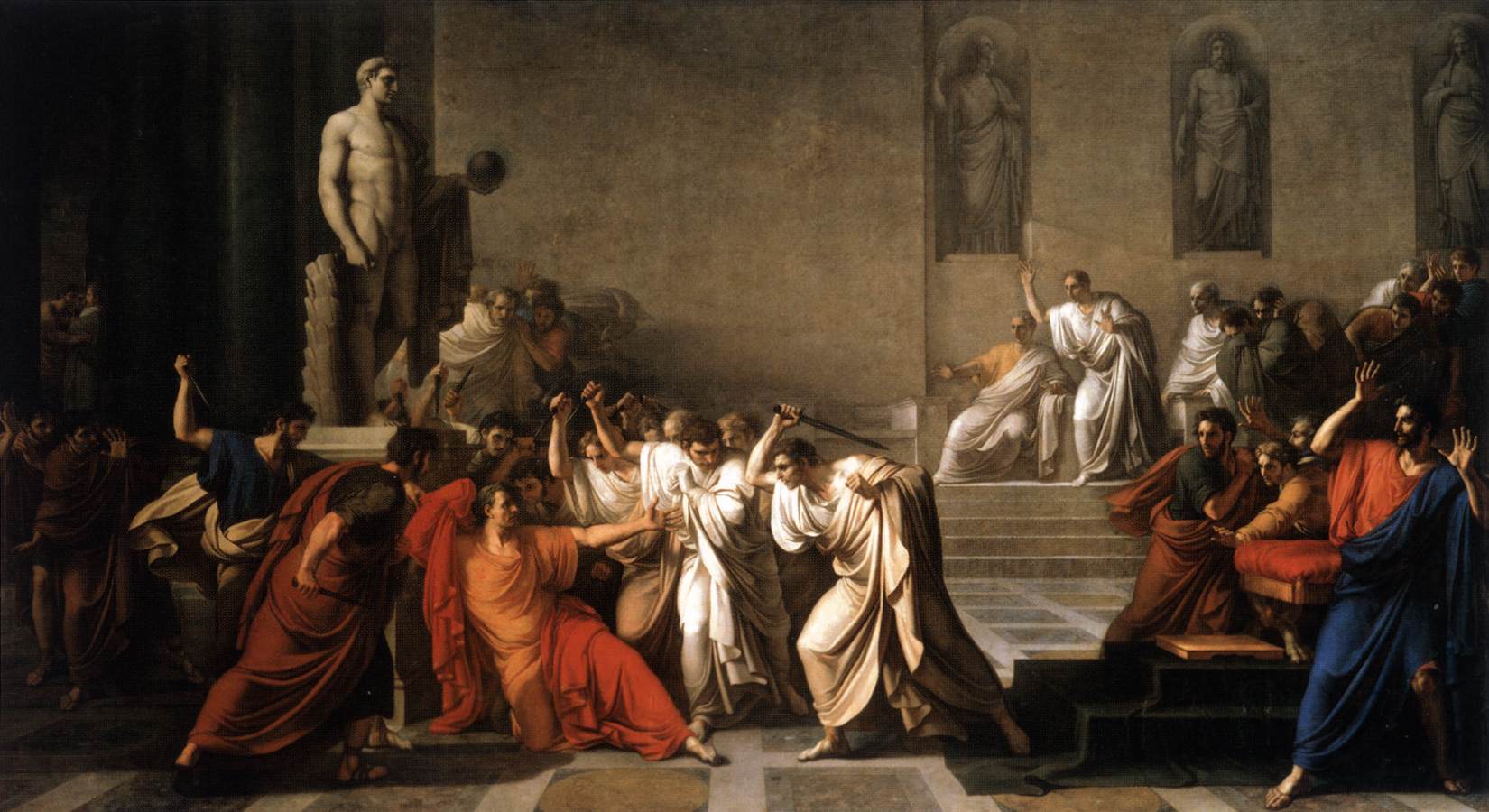
The Death of Caesar, by Vincenzo Camuccini (1773-1844)

*All quotes taken from “History’s Greatest Hits” by Joseph Cummins

Tuesday, November 27, 2012

William Wilberforce, by Alice


 On February 24th, 1793, a letter was written by a tired eighty-eight year old man, addressed to William Wilberforce.
 “Dear Sir,” it read. “Unless God has raised you up... I see not how you can go through with your glorious enterprise in opposing that execrable villainy... You will be worn out by the opposition of men and devils; but if God be for you, who can be against you?  Are all of them together stronger than God?  O, be not weary in well-doing.  Go on, in the name of God and in the power of His might, till even American slavery, the vilest that ever saw the sun, shall banish away before it.”

It was the last letter that tired old man ever wrote.  Just a week later, John Wesley was dead.

***

William Wilberforce was born sickly and almost blind.  His father, a merchant, died when he was just 9 years old; his mother, poor and unable to care for her young son, consigned him to the care of his Aunt and Uncle in Wimbledon.  There he received an education and adopted his relatives’ strong Evangelical views.  He regularly attended church, where he was often inspired by the preaching of John Newton.

At the age of 17, Wilberforce found his way to Cambridge University where he met and became close friends with the future Prime Minister, William Pitt.  Together they considered political careers and frequently watched House of Commons debates from the gallery.  While at Cambridge, Wilberforce engaged himself in little other than the playing of cards, gambling and intemperate drinking.  He had, however, a bright and cheery disposition and was admired by all his colleagues and those who encountered him.
In 1780, Wilberforce was elected to Parliament at the young age of 21.  In 1784 he became the independent Member of Parliament for Yorkshire, his home town.

After being converted in 1785, he made a radical change in his lifestyle and habits.  He became a conservative Christian, dedicated to prayer and spent much time in the Word.
Wilberforce met the Abolitionist Thomas Clarkson and a group of anti-slave-trade activists not long after his conversion.  Thomas Clarkson had an enormous influence on William, convincing him to take on the cause of abolition.  As a result, Wilberforce became one of the leading English Abolitionists and headed the Parliamentary campaign against the British slave trade.

William Wilberforce devoted his life to the cause of abolition and the work God called him to do.  As well as campaigning against the slave trade, he advocated legislations to improve the working conditions for chimney sweeps and textile workers, and engaged in prison reform.  He recognized the importance of education in alleviating poverty, and provided financial support for the establishment of Sunday Schools for the poor.  Yearly he gave away thousands of pounds; he paid off others’ debts and gave portions of his wealth to clergymen to distribute in their parishes.  He believed that those with wealth had a duty to give a significant portion of their income to the needy.

In 1797 Wilberforce met Barbara Spooner, a young anti-slavery supporter who was 18 years his junior.  They married after just two weeks of courtship and had six children.

William battled fiercely for many years to end the trade of slaves.
Finally, in February 1807, the bill to abolish the trading of slaves in the British Empire was passed.  This, however, did not release the millions of Africans already enslaved.  It merely ended the transporting of ‘cargo’.

Wilberforce fought for the next 27 years to free slaves in the British Empire.  He retired from Parliament in 1825 due to his failing health, only to return a few years later to lead yet another campaign against the slave trade.

After many years of hard work and perseverance, the bill was finally passed in 1833 to free slaves in the British Empire.

William Wilberforce died just 3 days later and was buried near his friend William Pitt in Westminster Abbey.

“When people speak of great men, they thing of men like Napoleon - men of violence. Rarely do they think of peaceful men.  But contrast the reception they will receive when they return home from their battles. Napoleon will arrive in pomp and in power, a man who’s achieved the very summit of earthly ambition.  William Wilberforce, however, will return to his family, lay his head on his pillow and remember: the slave trade is no more.”
-Charles Fox, from the film ‘Amazing Grace’


“You may choose to look the other way but you can never again say that you did now know.”  - William Wilberforce

Portrait of William Wilberforce by Karl Anton Hickel, c.1794

Friday, June 3, 2011

'The Misfortunes of William Reed' by Alice

Hi everyone!
Here is a short story I wrote last week. I hope you like it, and please leave a comment and tell me what you think! 
Enjoy!
Blessings,
Alice

"It was almost dawn. Will breathed heavily as his hands fumbled for the bridle in the dark. Ah! There it was.
‘Shhh......” He comforted Pippin as he slid the bridle over her long, brown neck; she began to whinny.
“Shhh...it’s just me.. the-re’s a girl.” His voice was barely a whisper, he couldn’t risk waking the stable boy who was no doubt sleeping right above him. Will rubbed her shoulder and said nothing. Time was running out. His heart beat faster by the minute.
Will led Pippin out of the stable and down an old alleyway. The town was still asleep and the steady clip-clop-clop of her hooves echoed throughout the streets.
Pippin trusted Will - they had played together in the pastures ever since she was a young foal. Now that she was fully grown, the old farmer had sold her to the Mayor. She had been overworked and beaten, and now Will, who was young and earnest, had come to free her.
Out in the fields, a rooster crowed. The sun was rising. The stable boy would soon be awake and realize Pippin was missing. He would inform the Mayor of the disappearance, who in turn would arouse the cops.
Will quickened his pace. His grasp on the reins tightened. Just a few more steps and around the corner, and the old dirt road that led out of the town would be in view.
The rooster crowed for the second time that morning. Smoke was starting to ascend out of the baker’s chimney, and farmers began heading out to their fields. The fishermen were coming ashore, and before long, children were out playing in the streets. The stable boy would be up and Pippin’s escape would have been discovered.
Will swung himself up onto Pippin’s bare back as they reached the end of the town, and together they swiftly sped down the old dirt road. How wonderful it felt to be riding Pippin again! He tossed his head back and let the early morning breeze rush through him. 
A sudden clip-clop-clop caught his attention: he turned his head and what he saw neither pleased nor surprised him. Several cops were on his tail.
“Yee-hah!” Will dug his heels into Pippin’s sides and together they sped down the old road. Excitement surged through him, pumping through his veins.They rounded the bend and the woods came into view. The cops were catching up. Faster and faster they ran, until they made it to the forest. The tall oaks closed in around them and for a heartbeat Will thought they had lost the cops, but alas! Round the bend they came and would be upon him any minute. 
In a moment of despair, Will realized it was Pippin’s freedom or his. Without hesitation he descended the horse and, with one last glance into her sparkling eyes, slapped and sent her scooting off into the thickets. She was free.
Will instantly turned his attention to his own fate. One by one the cops surrounded him. He was trapped, and he knew it. With great despair, he turned his head, hoping to get one last glimpse of his treasured horse. But she was gone. 
Will woke up, screaming. The pain from his fresh wounds surged through his body, and memories from the past haunted him as if they happened yesterday. Then he remembered his attempt to escape...fifty lashes... salt on his wounds... He couldn’t remember anything after the salt. He guessed he had fallen unconscious.
There was a stomping of boots outside and the door flew open.
“You’re awake!” 
The Warden’s words were like a dog’s bark, short and stubborn.
“I...er.... ahhhhh.......” 
“Speak up boy! Cat got yer tongue??”
“N-n-noo s-s-irr, I... er...” Will could barely raise his voice above a whisper. The pain was too great. He sunk back into his bed and before he knew it, fell unconscious again.
Once again Will was haunted by the past. Images flickered in his mind, refusing to leave him alone. 
“Order! Order! Order in the court!” Three times the Judge tapped his hammer on the desk.
“Who brings charges against this man??”
A short, fat, stumpy old man stood up. He was an ugly man, his face covered in wrinkles and scorn. He was the Mayor.
“I do!”
“And what is your charge against him?” 
The Mayor  looked at Will. For a moment, Will thought he saw pity in his eyes, but it vanished like a lightning bolt. 
“Horse theft!” 
“And are there any witnesses?”
A small boy of about ten stood up. “I saw him! I saw him take the horse! He walked right out of the stable and down the street. I saw him!”
Curse him! Will silently thought. He looked around the room and saw the police officers. The Mayor. The boy. He had no chance of getting away, no excuses, and he knew it.
“I hereby sentence...”
A commotion arose above the court. The judge was old and weary and barely had the strength to sentence Will.
“Order! Order! I hereby sentence William A. Reed to imprisonment for life, for horse theft. Order! Order!”
Will’s eyes flickered open. Sweat ran down his cheeks as he gasped for air. The pain was still insufferable; his back was covered in scars and so was his heart. I can’t carry on like this, he thought.
As the days rolled by, Will’s wounds began to heal. Presently, the Warden came back to fetch him.
“Aye, ye ready to go back to work?” he snapped.
“No, s-sir.”
The Warden struck Will across the face.
"I said, are ye ready to go back to work?"
“Y-yes sir - sir.” 
The Warden fastened irons around Will’s hands and pushed him outside. 
As he took a breath of fresh air, he looked up to the sky and let the warmth of the sun sink into his skin. How wonderful it felt! 
“Oi, enough o’ that! Keep moving!”
“Yes, sir.”
The Warden dragged Will out to the fields to begin his days work. He unlocked the irons, barked a few quick orders, then left. 
“Hey mate.” Will turned to see his friend George working beside him. “You all right?” 
“Yeh, I’m all right” he acknowledged.
There was no expression in his words. No happiness, no sadness, no nothing. They were just words, empty words.
As the day wore on, Will slaved away at his work. The sun grew hotter and began to sink into his wounds, and with it the hope of the future disappeared. "


THE END